
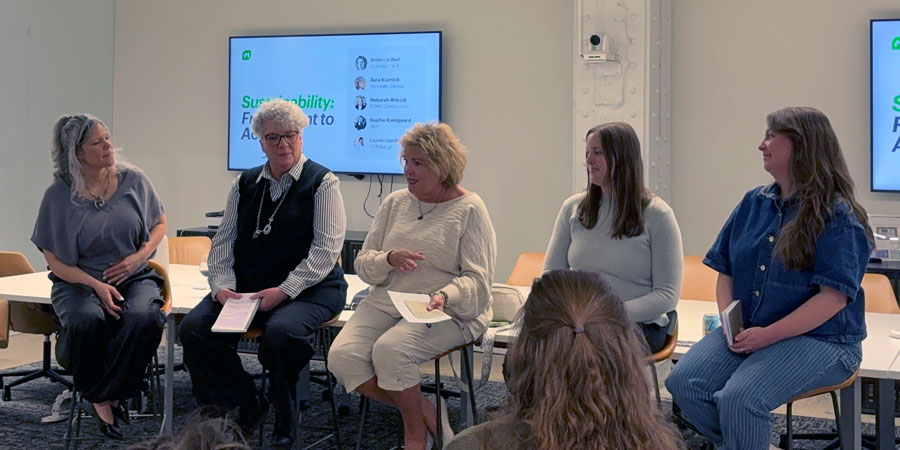
Stahl Construction was proud to participate in the Design Your Impact CEU Series, hosted by Rebecca Elie Best of Material Bank, an educational event focused on advancing real-world sustainability strategies across the built environment.
Structured as an interactive panel discussion, the event brought together leaders representing every phase of the construction process — ownership, design, and construction — for an honest conversation about what it truly takes to deliver more sustainable projects today.
A Cross-Disciplinary Perspective on What Works
The panel featured industry professionals with firsthand experience implementing sustainable solutions on active commercial projects:
- Sara Kunnick, Interiors Section Manager, Hennepin County
- Sophie Kjeldgaard, Senior Interior Designer, HGA
- Lauren Gardener, Associate Interior Designer, MSR Design
- Deb Aldrich, Senior Project Manager, Stahl Construction
Moderated by Rebecca Best of Material Bank, the panelists shared candid insight into how teams are navigating the growing complexity of sustainability — balancing embodied and operational carbon goals, material health and transparency, circularity, budgets, and client expectations, all at once.
Rather than staying in theory, the discussion focused on what is actually working in practice. Panelists explored where sustainability efforts gain traction, where implementation still breaks down, and how stronger alignment between internal teams and external partners leads to better outcomes.
“Being part of a cross‑disciplinary panel like this was incredibly energizing. The conversation was practical and honest — focused not just on what’s working today, but on pulling back the curtain to identify the gaps and barriers across disciplines that can slow progress, and how we can work together to move sustainability forward in more meaningful ways.”
— Deb Aldrich, Senior Project Manager, Stahl Construction

Practical Takeaways for Active Projects
Attendees heard real-life examples of how project teams are reducing carbon impacts without blowing up budgets, along with lessons learned from projects where good intentions met real-world constraints. The conversation emphasized the power of small, repeatable actions — decisions that may seem minor individually but compound into measurable impact over time.
- Start with materials already approved — then improve from there.
Panelists emphasized that sustainability progress often begins by evaluating materials already familiar to clients and contractors. Rather than introducing entirely new products, teams are finding success by selecting lower-carbon or healthier alternatives within approved product families, reducing risk while still improving performance. - Use cost-neutral swaps to build momentum.
Rather than framing sustainability as an added expense, speakers shared examples of identifying material substitutions that maintain budget while reducing embodied carbon or improving material health. These early “wins” help build trust with clients and create space for deeper sustainability conversations later in the project. - Bring construction expertise into sustainability decisions earlier.
Early collaboration between designers and construction teams was repeatedly highlighted as key to avoiding late-stage breakdowns. When constructability, availability, and sequencing are considered early, sustainability goals are more likely to survive budget and schedule pressures. - Align teams around shared priorities, not checklists.
Rather than chasing every sustainability metric at once, panelists noted the value of aligning teams around a small set of shared, achievable goals. Establishing consensus early — across owners, designers, and builders — helps teams make faster decisions and avoid misalignment later. - Focus on repeatable actions that scale across projects.
The discussion reinforced that measurable impact doesn’t always come from one big decision. Small, repeatable choices — like standardizing healthier finish selections or streamlining material vetting — compound across multiple projects and teams, creating long-term impact without added complexity.
By sharing perspectives from the client, design, and construction sides of the table, the panel highlighted the importance of early collaboration, clear communication, and shared accountability in making sustainable choices stick.
The result was an engaging, practical conversation that left attendees with tangible insights they could immediately apply to active projects — especially those feeling the pressure of making sustainability goals achievable, not just aspirational.
Designed to Build Momentum Through Collaboration
Material Bank’s Design Your Impact Education Series is centered on turning conversation into collaboration. By hosting these discussions across North America, Material Bank brings local industry leaders together to share project experience, challenges, and opportunities — building momentum around shared sustainability goals and accelerating the shift toward healthier, more responsible material choices.
For participants, the event reinforced that while sustainability can feel messy in practice, meaningful progress happens when teams commit to learning from one another and focusing on solutions that work in the real world.

What is Material Bank and Why is it Sustainable?
Material Bank is a technology-driven platform that allows architects and designers to search, select, and receive samples of architectural and design materials from hundreds of manufacturers in one place.
Instead of multiple shipments from individual vendors, Material Bank consolidates samples into a single, carbon-neutral shipment, delivered overnight in a reusable and returnable box. This streamlined process reduces waste, limits unnecessary packaging, and significantly cuts down on emissions traditionally associated with material sampling.
By centralizing sample ordering and providing access to detailed product data, Material Bank helps design teams work more efficiently while making more informed, responsible material decisions. To date, this approach has prevented over 7.7 million individual packages from being shipped — demonstrating how smarter systems can drive meaningful environmental impact.